
The Difference That Defines Reputation
In many organizations, work gets done every day. Tasks are completed, requests are handled, and services are delivered on time. On the surface, everything appears functional. But beneath this activity lies a critical question: are you truly offering quality, or are you simply serving?
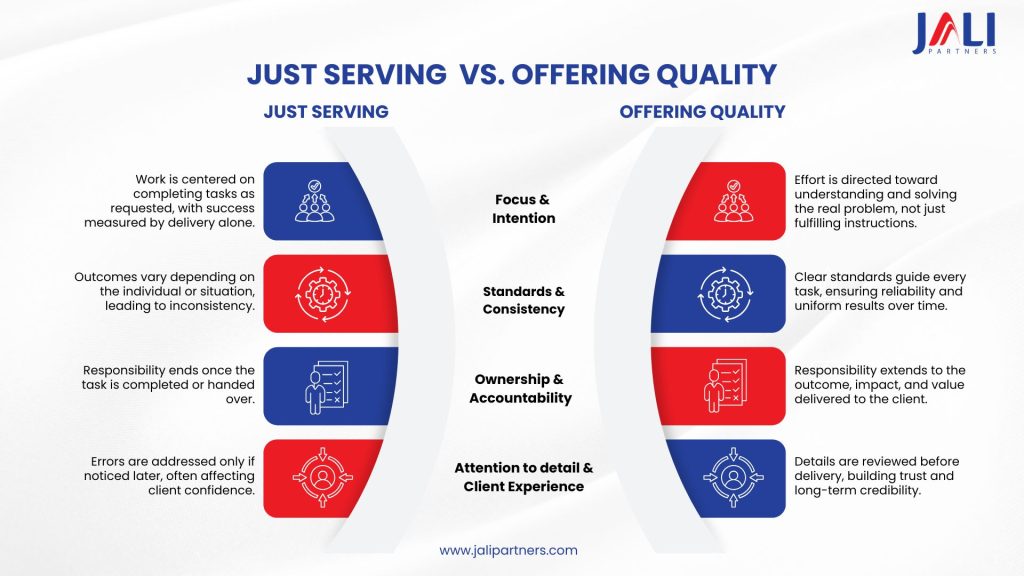
Serving is about completion. Quality is about intention. One meets expectations; the other builds trust. Over time, this distinction defines how clients perceive your business, how teams take pride in their work, and how sustainable performance really is.
When “Done” Is Not the Same as “Done Well”
Serving focuses on closing tasks. The goal is to respond, deliver, and move on. While this keeps operations moving, it often leaves little room for reflection, improvement, or ownership. Work becomes transactional, and standards gradually erode.
Quality, on the other hand, demands consistency and attention to detail. It asks critical questions:
- Does the outcome truly solve the problem?
- Does it align with agreed standards?
- Does it add value beyond the minimum requirement?
Organizations committed to quality do not rush to finish; they focus on finishing right. Over time, clients notice the difference, even if they cannot immediately articulate it.
The Hidden Cost of “Just Serving”
Organizations operating in service-only mode often pay a silent price. Errors increase, rework becomes common, and teams spend time fixing preventable issues. Client feedback becomes reactive rather than positive, and internal morale weakens as work feels repetitive rather than meaningful. Efficiency without quality is a false economy, time saved upfront is often lost later through corrections, explanations, and damaged trust.
Quality reduces these costs by embedding care and accountability into every step of the process.
Just Serving vs. Offering Quality
Why Quality Requires Structure
Quality does not emerge from good intentions alone. It thrives in organizations with clear processes, defined responsibilities, standard templates, and consistent review mechanisms. Without structure, teams rely on individual judgment, which leads to inconsistency. With structure, quality becomes repeatable, measurable, and reliable, turning individual excellence into organizational performance.
The Role of Leadership in Setting the Standard
Quality starts at the top. Leaders define what is acceptable by what they tolerate, reward, and review. When leadership prioritizes speed over accuracy, teams follow suit. When leadership values clarity, discipline, and continuous improvement, quality becomes part of the culture. Leadership transforms quality from a slogan into an expectation, and from an expectation into a habit.
Strategic Reflection
Serving keeps operations running. Quality builds credibility, trust, and long-term performance. Organizations that focus only on serving may stay busy, but those that commit to quality stand out. The question is not whether work is being done, it is whether it is being done with intention, consistency, and value.
In the long run, quality is not an extra effort. It is the standard that separates ordinary service from meaningful impact.