

Every organization invests time in strategy. Plans are refined, objectives clarified, and priorities communicated with confidence. Yet, months later, many leaders find themselves asking a quiet but familiar question: Why aren’t the results matching the ambition of the plan? The issue is rarely the absence of strategy. More often, it lies in what happens after the strategy is approved, when intentions meet day-to-day decisions, competing priorities, and real-world constraints.
Peter Drucker once observed, “Plans are only good intentions unless they immediately degenerate into hard work.” What often goes unexamined is who owns that transformation from intention to outcome. Execution is not simply about getting things done. It is the mechanism through which strategy becomes reality, and it demands far more than operational efficiency alone.
Execution Is More Than Doing the Work
Execution is frequently associated with implementation: meeting deadlines, following procedures, delivering outputs. These elements are visible and measurable. Yet they are only the surface. As strategy moves into action, complexity increases. Trade-offs emerge. Assumptions are tested. Priorities that once seemed clear begin to compete. In these moments, execution becomes less about process and more about judgment.
It raises important questions that are rarely written into project plans:
- What gets prioritized when everything feels urgent?
- How are decisions made when information is incomplete?
- Who ensures alignment when conditions change?
Execution quality is shaped in these moments, not in task lists, but in decisions. And decisions, by nature, are a leadership act. The real work of leadership begins after the strategy presentation ends.
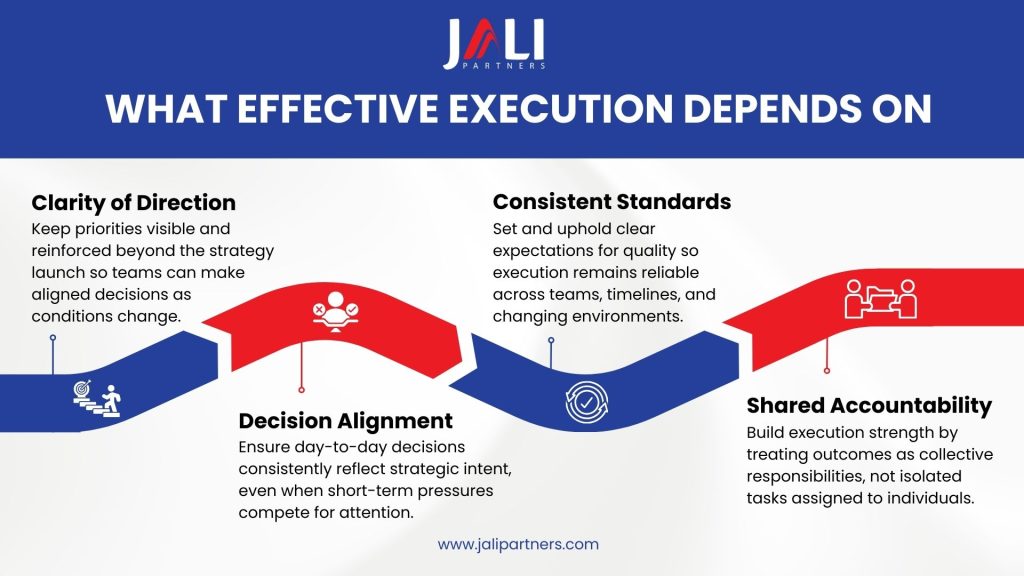
What Effective Execution Depends On
Why Execution Benefits from Leadership Continuity
Execution unfolds over time, not in a single moment. As initiatives progress, assumptions shift and new information emerges. What mattered at the start may need refinement along the way. Leadership continuity provides a stabilizing force through this process. It ensures that adjustments remain aligned with purpose rather than reactive to circumstance. This does not require constant intervention, but it does require presence.
When leaders stay connected to execution, they reinforce priorities, enable timely course correction, and create space for thoughtful problem-solving. The result is not tighter control, but clearer direction. Organizations that maintain this connection tend to experience fewer surprises, not because challenges disappear, but because they are addressed earlier and more deliberately.
Building Stronger Execution Across the Organization
Improving execution is rarely about asking teams to work harder. More often, it is about reducing friction, clarifying expectations, strengthening communication, and ensuring that decisions reinforce, rather than dilute, strategy.
When execution is understood as a leadership capability rather than a handoff, coherence replaces confusion. Teams gain clarity on what matters most. Decisions become more consistent. Performance becomes more predictable. Over time, this consistency builds trust, within teams, across functions, and with external stakeholders.
As the saying goes, “What gets reinforced gets repeated.” Execution is no exception.
Closing Perspective
Execution is where strategy proves its value. It is where intent becomes action and ambition becomes measurable impact. Organizations that recognize execution as a leadership skill, supported by structure, alignment, and continuity, move beyond asking why plans fail. Instead, they focus on how leadership practices can strengthen outcomes across the organization.
When execution is understood this way, it stops being a source of frustration and becomes a source of confidence, quietly, consistently, and sustainably.