

Every organization makes plans. Targets are set, projections are built, and expectations are clearly defined. At the beginning, there is confidence in the numbers and clarity in the direction. But as time passes, reality begins to unfold. Results come in, conditions change, and actual performance starts to tell a different story.
This is where many organizations face a quiet challenge, not in planning, but in understanding the gap between what was expected and what actually happened. Projection without tracking creates assumptions. Tracking without reflection creates reports. The real value lies in connecting both.
But the real question is:
Do your numbers tell the same story you planned for?
Where the Gap Begins
Projections are built on assumptions about markets, costs, performance, and timing. They represent the best understanding at a given moment. Actual results, however, reflect real conditions. They reveal what worked, what didn’t, and where expectations did not align with reality.
When these two are not actively compared, organizations risk continuing with outdated assumptions, missing opportunities to adjust early.
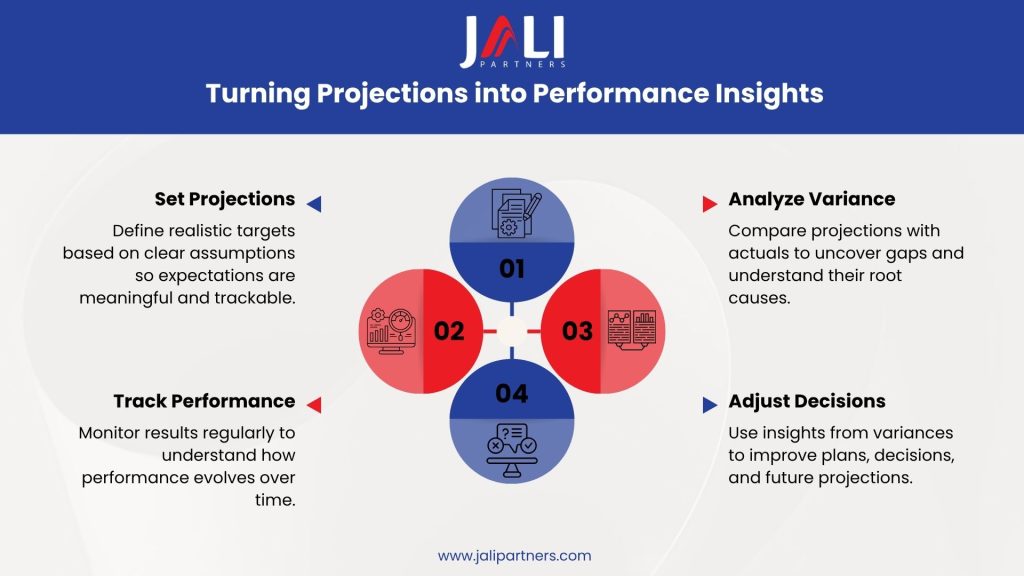
Turning Projections into Performance Insights
Tracking Is Not Just Reporting
In many cases, tracking becomes a routine exercise, numbers are reported, variances are noted, and reports are shared. But without deeper analysis, this process adds limited value. The purpose of tracking is not only to show differences, it is to explain them and learn from them.
When organizations treat tracking as a learning tool rather than a reporting task, they gain clarity that supports better decisions.
From Numbers to Insight
The real benefit of projection vs actual tracking lies in the questions it helps answer:
- Why did performance differ from expectations?
- Were assumptions realistic?
- What needs to change moving forward?
These insights allow organizations to move from reactive adjustments to proactive decision-making. Over time, this strengthens both planning accuracy and execution quality.
What This Means in Practice
Effective organizations do not expect projections to be perfect. Instead, they focus on how quickly and accurately they respond to differences. By consistently comparing projections with actual performance, they create a feedback loop, one that improves understanding, sharpens decisions, and reduces uncertainty over time.
This approach turns planning into a dynamic process rather than a one-time exercise.
Closing Insight
Projections set direction. Actual results reveal reality.
The value lies in the connection between the two.
Organizations that actively track, understand, and respond to performance gaps do more than measure results, they improve them. Because in the end, performance is not defined by what was planned, but by how well organizations adapt when plans meet reality.