

Many small and growing businesses believe the biggest barrier to growth is lack of capital. And in many cases, funding is indeed important. Businesses need resources to invest, expand, hire, and operate effectively. Because of this, access to finance is often viewed as the main solution to business growth challenges. But an important reality is often overlooked, not every business with funding grows successfully.
Some businesses receive capital and still struggle to scale, while others operate with limited resources yet continue to grow steadily over time. This suggests that growth is influenced by more than funding alone. In many cases, the difference lies in how businesses manage operations, make decisions, allocate resources, and adapt to changing conditions. This raises an important question:
If access to capital matters so much, why do some SMEs still fail to grow after receiving it?
The answer often lies beyond funding itself. While capital can support growth, it does not automatically create it. Sustainable growth usually depends on whether the business has the discipline, structure, and strategic direction required to turn financial resources into long-term progress.
Why Growth Still Stalls After Funding
Access to capital can solve immediate financial pressure, but it cannot automatically fix deeper operational and strategic challenges. In many SMEs, growth slows not because money is unavailable, but because priorities are unclear, financial discipline is weak, operations cannot scale efficiently, or decisions are made without reliable information.
As a result, businesses may gain access to funding but still struggle to convert that funding into sustainable progress. In some cases, expansion happens too quickly without the systems required to support it. In others, resources are spent reactively instead of strategically, creating short-term activity without long-term stability.
This is why growth should not only be viewed as a financing challenge, it is also a management, strategy, and execution challenge. Businesses that grow consistently are often those that combine funding with strong decision-making, operational control, and long-term planning.
What Truly Drives SME Growth
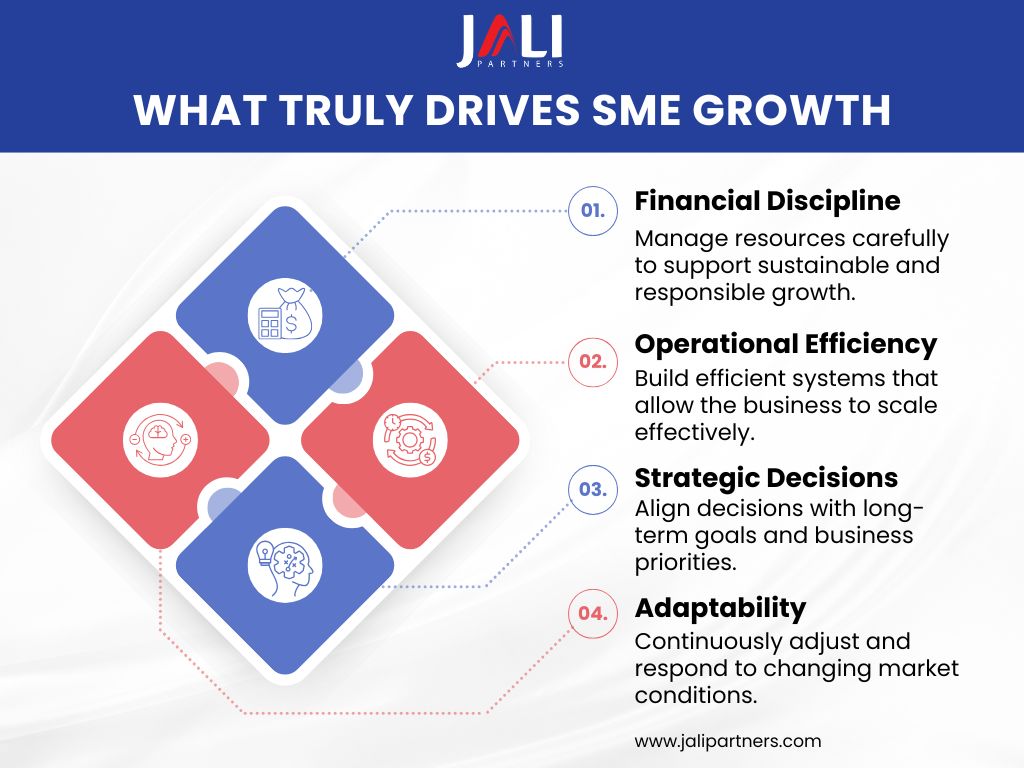
What Sustainable Growth Actually Depends On
Capital is often most effective when the business already has strong foundations. Funding can accelerate progress, but it cannot replace structure, discipline, or direction. Without clear financial management, funding can disappear quickly. Without operational structure, growth can create confusion instead of progress. Without strategy, expansion efforts may become reactive rather than intentional.
This is why some businesses appear to grow on the surface, through increased sales, activity, or expansion, while internally becoming less stable over time. Rapid growth without strong foundations can create pressure on operations, finances, and decision-making, eventually weakening the business instead of strengthening it. True growth is not only about becoming bigger. It is about becoming stronger, more efficient, and more sustainable over time.
Why Readiness Matters as Much as Funding
Sometimes the real challenge is not access to capital, but readiness to use capital effectively. A business may secure funding, but still struggle to answer important questions:
- Where should resources be prioritized?
- Which investments create long-term value?
- Can operations support expansion?
- Are risks being managed carefully?
These questions determine whether capital becomes a growth tool, or simply temporary relief. Because capital accelerates what already exists. If systems, discipline, and direction are weak, growth pressure can expose those weaknesses even faster. This is why readiness matters as much as funding itself. Businesses that are financially organized, operationally prepared, and strategically focused are usually better positioned to turn funding into measurable progress and sustainable growth.
What Growing Businesses Should Focus On
For SMEs seeking sustainable growth, financing should be viewed as one part of a larger growth strategy, not the entire strategy itself. While funding can create opportunities, long-term success often depends on how effectively businesses manage and use those opportunities over time.
Businesses that grow consistently often focus on improving financial management, strengthening operations, building decision-making discipline, understanding customers and markets, and developing the ability to adapt over time. These capabilities help businesses remain stable during uncertainty and position them to scale more effectively when opportunities arise. Over time, these foundations create businesses that are not only capable of growing, but also capable of sustaining that growth responsibly and consistently.
Breakthrough Perspectives
Access to capital matters, but capital alone does not guarantee growth. Sustainable SME growth is usually driven by a combination of financial discipline, operational strength, strategic clarity, and adaptability. Because in the end, growth is not simply about gaining more resources. It is about building a business capable of using those resources wisely, consistently, and sustainably.