

What Gives One Business an Advantage When Others Have Access to the Same Resources?
Technology, data, and AI are becoming widely accessible, yet organizations operating in the same markets often achieve very different results. The difference is rarely the information they have, it’s how they use it. Knowledge enables organizations to make better decisions, solve problems, adapt to change, and create lasting value. While organizations have invested heavily in data, knowledge and human judgment are becoming the true differentiators in an AI-driven world.
Information Shows the Road. Knowledge Chooses the Best Route.
Imagine two people driving to the same destination with the same GPS and traffic updates. One arrives on time while the other gets delayed. The difference isn’t the information, it is how they interpreted it. One anticipated the traffic and chose a better route, while the other simply followed the suggested path.
Businesses operate the same way. Many organizations have access to similar data, technologies, and AI tools, but the organizations that consistently succeed are those that know how to transform information into better decisions. That ability is knowledge.
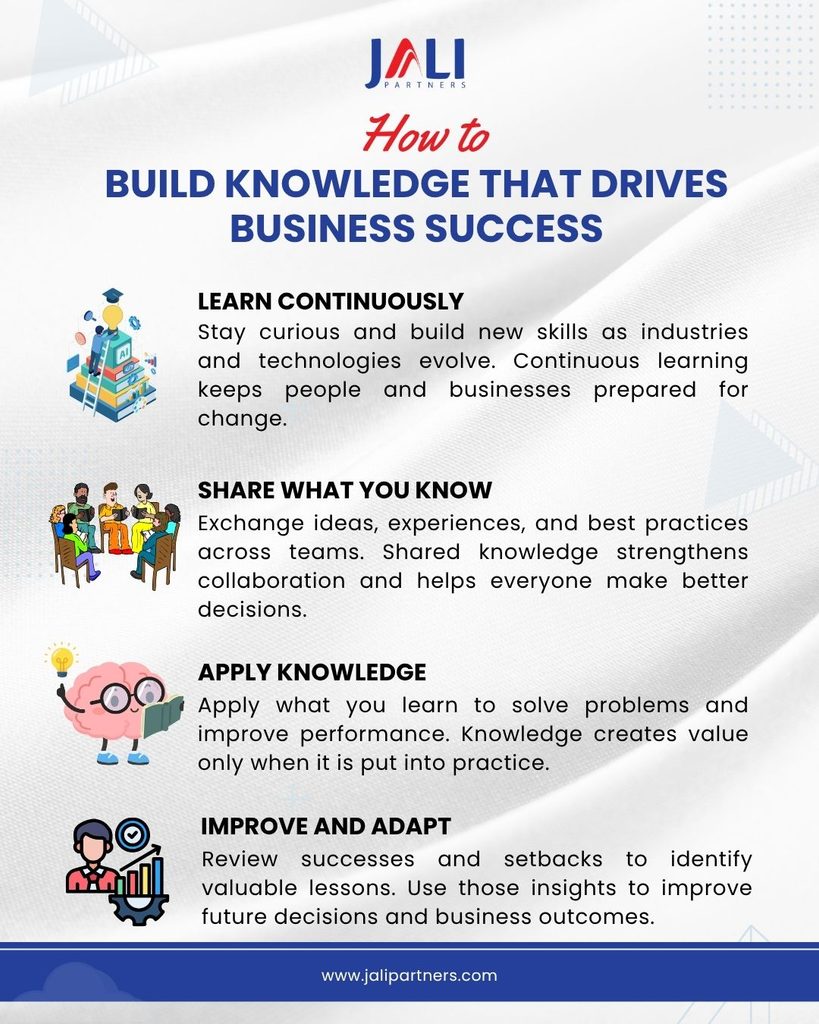
How to Build Knowledge That Drives Business Success
Why Knowledge Matters More Than Ever
Business conditions are changing faster than ever. New technologies emerge, customer expectations evolve, and markets become increasingly competitive. Organizations that learn continuously can respond to these changes with greater confidence. Instead of reacting to uncertainty, they use knowledge to recognize opportunities, manage risks, and make informed decisions.
Knowledge Grows When It Is Shared
Unlike physical assets, knowledge becomes more valuable when it is shared. When organizations encourage collaboration, document lessons learned, and create opportunities for continuous learning, individual expertise becomes organizational capability. This not only improves daily decision-making but also strengthens innovation, resilience, and long-term performance.
Building Knowledge as Business Infrastructure
Just as businesses invest in technology, financial systems, and operational processes, they should also invest in building knowledge. This means promoting continuous learning, encouraging knowledge sharing, capturing lessons from experience, and creating an environment where people can confidently apply what they know.
Organizations that treat knowledge as infrastructure are often better prepared to adapt, innovate, and sustain growth, regardless of how quickly the business environment changes.
Core Insights
Technology and AI will continue to transform how businesses operate, but they cannot replace the value of knowledge. Organizations that continuously learn, share knowledge, and apply it effectively are better positioned to make smarter decisions, adapt to change, and create sustainable growth. Because in today’s business environment, competitive advantage is no longer defined by who has the most information, it is defined by who knows how to turn information into meaningful action.