

What if the future unfolds differently than everything you’ve planned for?
Most organizations spend significant time developing forecasts, building strategies, and setting long-term goals. These activities are important because they provide direction and help allocate resources effectively. But recent years have revealed an uncomfortable reality: some of the most significant events shaping businesses, industries, and economies were difficult or even impossible to predict with certainty.
Markets shift unexpectedly. Technologies emerge rapidly. Customer behaviors evolve. Economic conditions change. New opportunities appear where none were anticipated, while familiar assumptions suddenly become unreliable. This raises an important question:
If the future cannot be predicted perfectly, how should organizations prepare for it?
The answer may not lie in better prediction alone. It may lie in building the ability to adapt, learn, and respond when the unexpected arrives.
The Prediction Trap
Many organizations unknowingly treat planning as an attempt to predict the future. They create detailed projections, establish fixed assumptions, and build strategies around a single expected outcome. While this can provide clarity, it can also create vulnerability.
The challenge is not that planning is wrong. The challenge is believing that today’s assumptions will remain true tomorrow. When organizations become too attached to one version of the future, they often struggle when conditions change. A more resilient approach is to recognize that uncertainty is not a temporary obstacle, it is a permanent feature of decision-making.
Thriving in Uncertainty
Why Adaptability Is Becoming a Competitive Advantage
In the past, competitive advantage often came from scale, efficiency, or access to resources. Today, another capability is becoming increasingly important: adaptability. Organizations that adapt quickly can respond to changing customer needs, emerging technologies, new regulations, and unexpected disruptions more effectively than those waiting for certainty.
Adaptability does not mean constantly changing direction. It means maintaining a clear purpose while remaining flexible about how that purpose is achieved. In uncertain environments, the ability to adjust may become more valuable than the ability to predict.
From Forecasting to Scenario Thinking
Forecasts remain useful, but they become far more powerful when combined with scenario thinking. Instead of asking: “What will happen?” Organizations can ask: “What could happen?” This subtle shift changes how decisions are made.
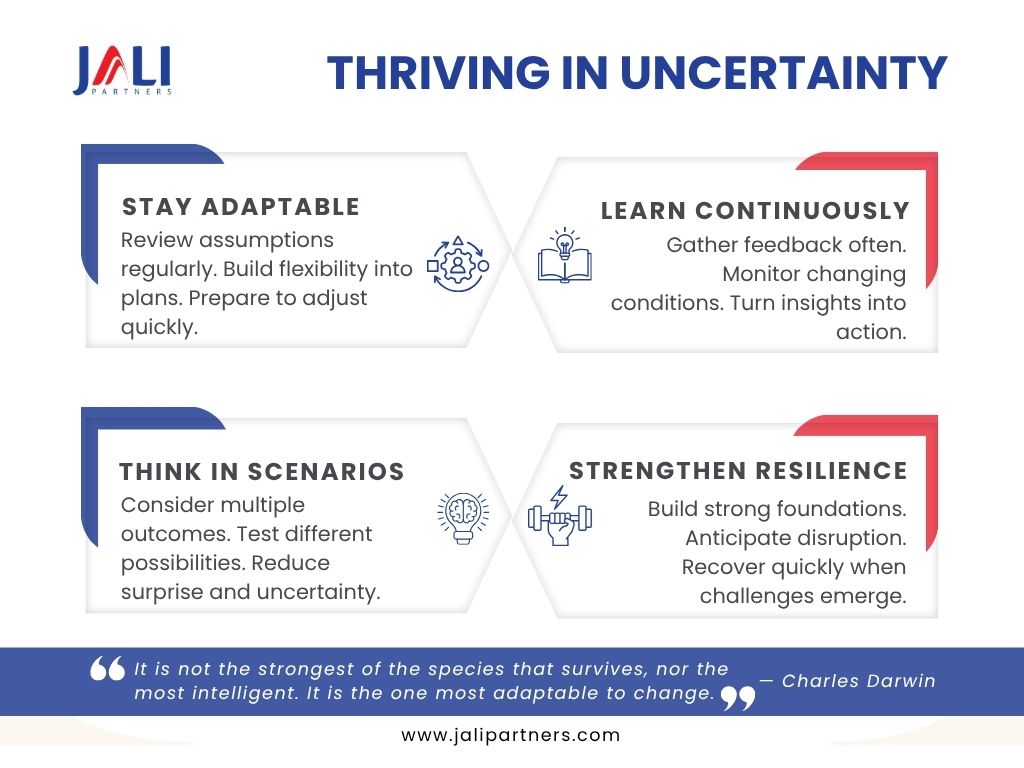
Scenario thinking encourages leaders to explore multiple possibilities, identify potential risks earlier, and recognize opportunities that may otherwise go unnoticed. Rather than preparing for one future, organizations become prepared for several.
The Organizations That Learn Fast Win Faster
One of the most overlooked capabilities in uncertain environments is learning speed. The future often rewards organizations that can learn faster than conditions change. These organizations actively gather feedback, monitor trends, test ideas, and adjust decisions based on new information. They view mistakes as sources of insight, not simply failures. Over time, this creates a cycle of continuous improvement that strengthens both performance and resilience. Because when the future is uncertain, learning becomes a strategic advantage.
What This Means in Practice
Preparing for an uncertain future does not require predicting every possibility. Instead, it requires building capabilities that remain valuable regardless of what happens next. Organizations can strengthen their readiness by encouraging continuous learning, reviewing assumptions regularly, developing flexible strategies, investing in resilience, and improving decision-making processes. These practices do not eliminate uncertainty, they improve the ability to navigate it.
Closing Insight
The future has never been completely predictable. What has changed is the speed at which change now occurs. Organizations that succeed in uncertain environments are rarely those with the most accurate predictions. More often, they are the ones that adapt fastest, learn continuously, and remain prepared for multiple possibilities. Because the goal is not to predict the future perfectly. It is to build the capability to thrive no matter which future arrives.