

What makes an idea worth investing in, and not just worth discussing?
In every organization, new opportunities appear regularly. Some sound exciting, others look safe, and many appear promising at first glance. But experience shows something important: not everything that looks good is actually worth doing.
So the real challenge is not the lack of ideas, it is deciding:
Which ideas will actually work when real resources are committed?
This is where financial viability becomes critical. It helps separate what is possible from what is sustainable. Because in reality, organizations do not fail from lack of ideas, they struggle from investing in the wrong ones.
When “Good Ideas” Become Expensive Decisions
At the beginning, most initiatives look reasonable. Plans are clear, enthusiasm is high, and projections often support the decision. But over time, conditions change. Costs become clearer. Assumptions are tested. And reality begins to answer a different question:
Is this still worth continuing?
Without financial viability checks, organizations often discover too late that:
- costs were underestimated
- returns were overestimated
- risks were not fully understood
And by then, resources have already been committed.
How Financial Viability Is Evaluated
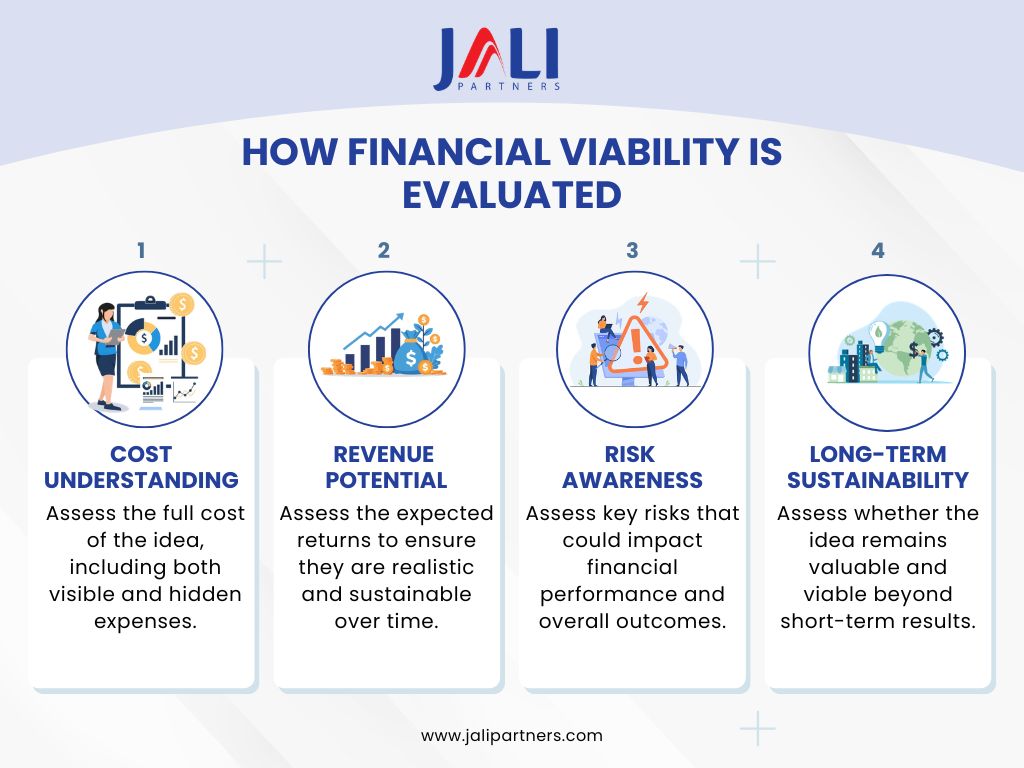
How Financial Viability Is Quantified in Practice
While financial viability is often discussed in strategic terms, organizations also rely on structured financial tools to support decision-making. One of the most widely used approaches is Net Present Value (NPV), a method that helps evaluate whether an investment creates value over time.
Instead of focusing only on total returns, NPV considers the timing of money, helping organizations understand whether future benefits are truly worth today’s investment.
Here are four key techniques used in NPV evaluation:
1. Forecast Future Cash Flows
Estimate all expected inflows and outflows generated by the project over time using realistic assumptions.
2. Apply a Discount Rate
Adjust future cash flows to reflect their present value, recognizing that money today carries more weight than money in the future.
3. Calculate Net Present Value
Subtract the present value of costs from the present value of benefits to determine whether the project creates net value.
4. Compare and Decide
A positive NPV generally signals value creation, while a negative NPV suggests the investment may not be financially sustainable under current assumptions. This is where financial viability moves from concept to calculation, helping organizations test whether ideas are not just attractive, but financially sound over time.
Why Numbers Alone Are Not Enough
It is easy to assume financial viability is just a numbers exercise. But two ideas can show similar financial projections and still produce very different outcomes.
Why? Because real-world execution is influenced by factors beyond spreadsheets, timing, capacity, market response, and operational complexity. This is why financial viability is not only about calculation. It is also about judgment.
It asks not only: “Can this work?” but also: “Will this still work under real conditions?”
The Real Purpose of Financial Viability
Many organizations do not struggle to generate ideas, they struggle to choose between them. Financial viability acts as a filter that brings clarity to decision-making. It shifts thinking from:
“Does this look good?” to “Is this worth the investment of time, money, and effort?”
It forces a disciplined conversation around:
- expected value
- required investment
- acceptable risk
- long-term impact
And that clarity is often what separates growth from waste.
How Organizations Use This in Decision-Making
Financial viability is not a one-time approval step, it is an ongoing discipline. As conditions change, assumptions must be revisited. What was viable at the beginning may not remain viable later, and vice versa.
Organizations that continuously evaluate viability tend to:
- allocate resources more effectively
- reduce wasted investment
- make more confident decisions under uncertainty
Over time, this builds stronger financial discipline across the organization.
Perceptive conclusions
Not every idea deserves investment, but every idea deserves evaluation.
Financial viability ensures decisions are not driven only by optimism, but by evidence, structure, and long-term thinking. Because in the end, success is not about doing more things. It is about doing the right things in a way that can sustain itself over time.