

At first glance, reconciliation may seem like a routine accounting task, something technical, repetitive, and mainly relevant at month-end. But in reality, reconciliation is far more important than many businesses realize. It is one of the processes that quietly protects financial accuracy, supports decision-making, and helps organizations detect problems before they become costly. And yet, many businesses still treat reconciliation as a secondary activity rather than a core financial discipline. Some assume reconciliation is only necessary for large organizations. Others believe automated systems can completely replace manual review. Many wait until month-end or year-end before checking whether financial records actually align.
These assumptions may seem harmless, but over time they can create serious financial risks. Because when reconciliation is weak, businesses may operate using incomplete, inaccurate, or misleading financial information, often without realizing it immediately.
What Financial Reconciliation Actually Means
Financial reconciliation is the process of comparing financial records from different sources to ensure they match accurately. This may include comparing:
- bank statements and cash records
- payment records and invoices
- internal accounts and external transactions
- system balances and actual financial activity
The purpose is not simply to “check numbers.” Reconciliation helps identify missing transactions, recording errors, duplicate entries, unauthorized activity, timing differences, and inconsistencies that may affect financial reporting. In simple terms, reconciliation helps businesses confirm that their financial information reflects reality. Without it, decisions may be made using inaccurate financial data, and inaccurate data often leads to inaccurate decisions.
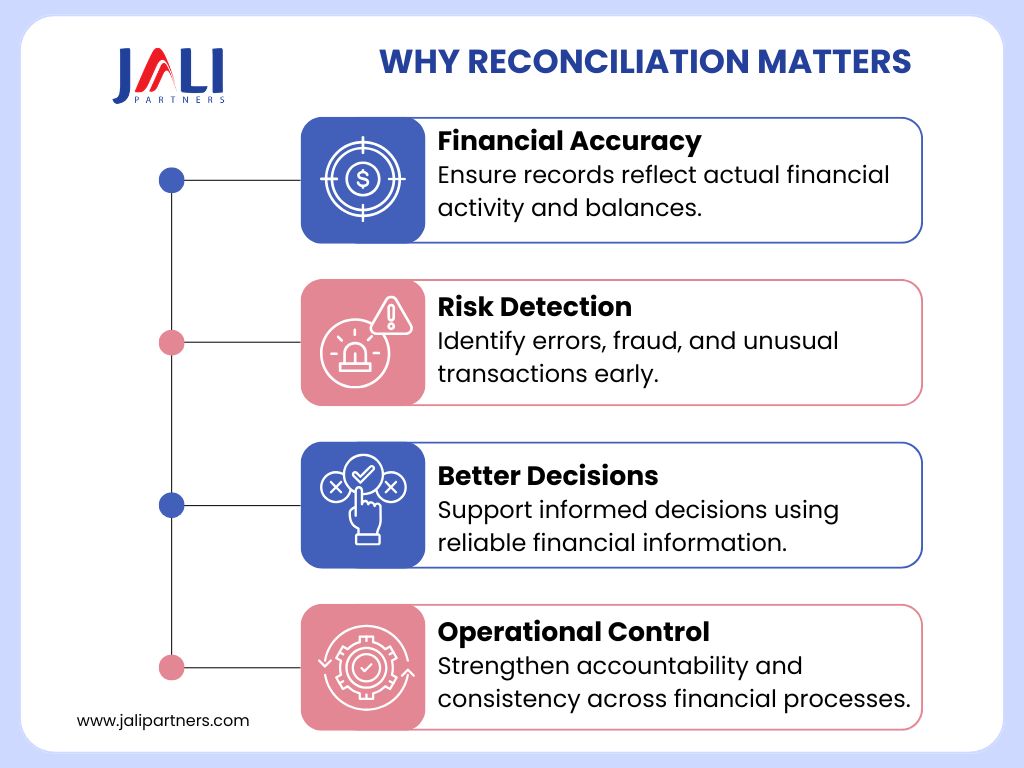
Why Reconciliation Matters
The Myths Many Businesses Still Believe
One reason reconciliation is often neglected is because of common misconceptions surrounding the process.
Myth 1: Reconciliation Is Only for Large Businesses
Many small businesses assume reconciliation is unnecessary because their operations are smaller or less complex. But smaller businesses are often more vulnerable to financial mistakes because they may have fewer controls and limited oversight.
In reality, reconciliation is important for every business size. Financial inaccuracies do not only affect large corporations, they can affect any organization that handles money, transactions, or financial reporting.
Myth 2: Automation Eliminates the Need for Human Review
Modern systems have improved financial processing significantly. Automation helps reduce manual work and improves efficiency. However, automated systems are not perfect.
Systems may miss unusual transactions, duplicate entries, timing issues, or incorrect classifications. Human review remains essential because financial reconciliation often requires judgment, investigation, and context, not just system matching. The strongest financial processes usually combine automation with consistent human oversight.
Myth 3: Reconciliation Is Only Necessary at Month-End
Many organizations treat reconciliation as a monthly or yearly exercise. But waiting too long to identify discrepancies can allow small issues to become larger financial problems. Frequent reconciliation improves visibility and allows businesses to detect errors earlier, improve cash management, strengthen financial control, and respond faster to unexpected issues.
The longer discrepancies remain unresolved, the harder they often become to trace and correct.
Why Reconciliation Is More Strategic Than It Seems
Reconciliation is often viewed as a back-office accounting process. But its impact reaches far beyond finance departments. Accurate reconciliation supports reliable financial reporting, stronger budgeting and forecasting, better cash flow visibility, regulatory compliance, and more confident business decisions.
When reconciliation is weak, organizations may unknowingly operate with distorted financial information. Over time, this can affect planning, investment decisions, profitability analysis, and overall business stability. In many cases, financial problems do not begin with lack of revenue, they begin with lack of financial visibility.
What Effective Reconciliation Requires
Strong reconciliation practices usually depend on more than software alone. They require clear financial processes, consistent review schedules, accountability and oversight, accurate documentation, and disciplined follow-through. Businesses that approach reconciliation proactively tend to identify problems earlier and maintain stronger financial control over time. Most importantly, reconciliation should not be treated as a routine task done only for compliance. It should be viewed as a continuous process that protects financial accuracy and supports organizational confidence.
Conclusion
Financial reconciliation may not always receive attention because it happens behind the scenes. But in reality, it is one of the processes that helps businesses operate with clarity, control, and trust in their financial information. Because in the end, strong financial decisions depend on strong financial visibility. And reconciliation is one of the key processes that makes that visibility possible.