

Growth has always been a priority for organizations, but today it is happening under very different conditions. Businesses are expected to move faster, operate more efficiently, respond quickly to uncertainty, and still maintain strong performance in highly competitive environments. At the same time, rising costs, changing customer behavior, and rapid technological shifts are making traditional growth approaches harder to sustain, as what worked in the past is no longer delivering the same results. This is why many organizations are beginning to rethink an important question: Can businesses continue growing using the same strategies in a world that is changing this quickly?
Increasingly, Artificial Intelligence (AI) is becoming part of this conversation—not just as a technology trend, but as a practical tool that may help organizations improve decision-making, efficiency, and adaptability under pressure. Recent industry findings, including insights from EY growth research, show that many business leaders now believe external pressure is forcing organizations to rethink how growth strategies are designed and executed. This reflects a broader shift happening across industries, where the focus is no longer only on achieving growth, but on sustaining it in uncertain conditions.
Why Growth Strategies Are Becoming More Complex
In stable environments, organizations often rely on predictable planning cycles, historical trends, and established operational models. However, today’s business environment has become far less predictable, with customer expectations shifting quickly, markets evolving faster, competition intensifying, and organizations increasingly expected to respond in near real time.
Under this pressure, traditional processes begin to show limitations. Large volumes of information become harder to analyze efficiently, decision-making slows down, and teams spend more time reacting to change rather than preparing for it. This growing complexity is one of the reasons AI is receiving increased attention, as businesses explore how it can help process information faster, identify patterns earlier, improve forecasting, and support quicker operational responses. The focus is no longer only on automation, but increasingly on adaptability.
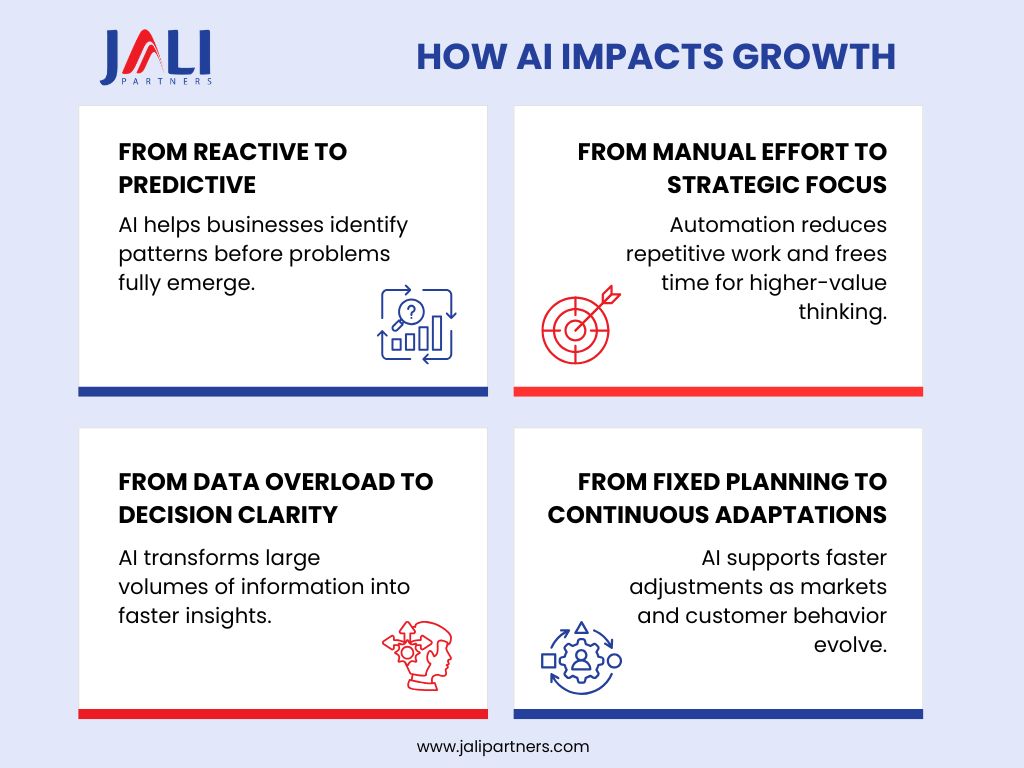
How AI Impacts Growth
AI Is Expanding Beyond Efficiency
Many organizations initially approached AI mainly as a productivity tool, using it to reduce repetitive tasks, improve speed, and increase operational efficiency. However, attention is now shifting toward a broader question: whether AI can directly contribute to strategic growth. This includes applications such as forecasting, customer behavior analysis, operational planning, financial analysis, and market trend identification, where AI can process large volumes of data much faster than traditional methods and uncover insights that may otherwise remain hidden.
However, technology alone does not automatically create growth. Organizations still need clear priorities, reliable data, strong leadership, and the ability to act on the insights generated. As many experts emphasize, the real value of AI lies not only in producing information, but in enabling better decisions from that information.
The Real Challenge Is Organizational Readiness
One of the biggest misconceptions about AI is that performance automatically improves once the technology is introduced. In reality, many organizations struggle not because AI lacks capability, but because their internal systems, processes, or structures are not fully prepared to support it. AI delivers the most value when organizations already have strong foundations such as clear strategic direction, reliable data, efficient processes, and leadership that is willing to adapt continuously. Without these elements, organizations may increase activity without necessarily improving outcomes.
This is why AI adoption is increasingly becoming less of a technology challenge and more of an organizational challenge. The question is no longer simply: “Do we have AI?” but rather: “Are we prepared to use AI effectively under real business conditions?”
Growth Under Pressure Requires Smarter Adaptation
Organizations today are operating in environments where pressure is unlikely to disappear soon. The ability to adapt quickly, learn continuously, and respond strategically is becoming increasingly important for sustainable growth. AI may help organizations improve forecasting, accelerate analysis, automate repetitive work, and strengthen decision-making. But long-term growth still depends on human judgment, adaptability, operational discipline, and strategic clarity.
The organizations that benefit most from AI will likely be those that combine technology with strong leadership, clear priorities, and the willingness to continuously evolve as conditions change. Because under pressure, growth is no longer only about expanding faster. It is also about becoming more responsive, more informed, and more prepared for what comes next.
Key Takeaways
Pressure is reshaping how organizations think about growth. Businesses are no longer operating in environments where long-term stability can always be assumed. Adaptability, speed, and decision quality are becoming critical growth capabilities.
AI may not replace strategy, leadership, or human judgment. But it is increasingly becoming one of the tools organizations use to navigate uncertainty and unlock new ways of growing in complex environments. Because in the end, sustainable growth under pressure is not only about working harder. It is about building the ability to think, respond, and adapt more intelligently to what comes next.