

What If Your Biggest Business Risk Isn’t a Bad Decision, But Too Many Decisions?
Every day, professionals make hundreds of decisions. Some are small; Which email should I answer first? Which task deserves my attention? Should this meeting happen today? Others carry greater consequences; Should we approve this investment? Is this the right person to hire? Should we expand into a new market? Is this the right financial decision?
We often assume that good decision-making depends only on experience, intelligence, or expertise. But research tells us something different. The quality of our decisions can decline simply because we’ve made too many of them.
This phenomenon is known as decision fatigue, the gradual deterioration in judgment after a long series of decisions. The problem isn’t that we stop making decisions. The problem is that we begin making worse ones.
Good Decisions Don’t Only Depend on Knowledge, They Depend on Capacity
Imagine a finance manager reviewing financial reports after eight hours of meetings. Or a business owner responding to the twentieth request for approval that day. Or a hiring manager interviewing candidates late in the afternoon after solving operational problems all morning. They still possess the same knowledge and experience. Yet their mental capacity has changed.
When decision fatigue sets in, people are more likely to delay important decisions, choose the easiest option instead of the best one, rely on habit without questioning it, avoid difficult conversations, and miss important details. Over time, these small compromises can become costly for both individuals and organizations.
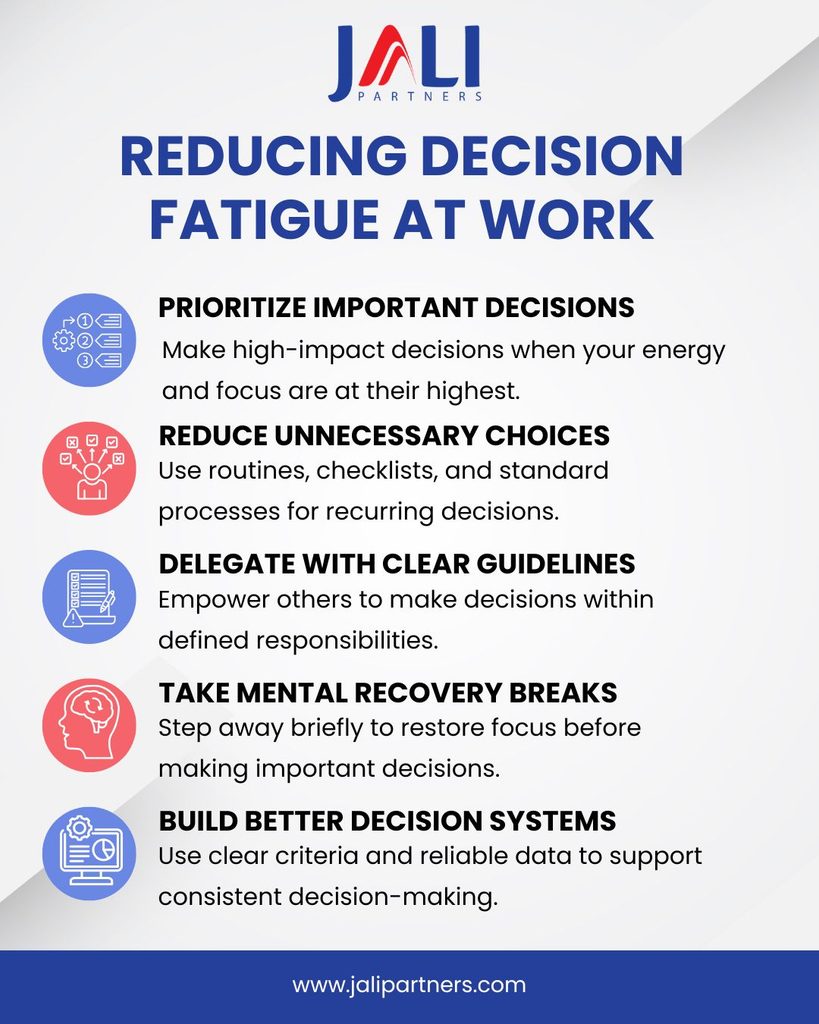
Reducing Decision Fatigue at Work
The Cost Is Often Invisible
Decision fatigue rarely announces itself, it doesn’t appear as an error message or a warning notification. Instead, it quietly influences how people think and work. Projects take longer to approve, meetings become less productive, risk assessments become rushed, and customer issues remain unresolved. Innovation slows because people default to familiar solutions instead of exploring better ones. Organizations often attribute these outcomes to workload or lack of motivation. Sometimes the real issue is simpler; people are mentally exhausted from making too many decisions.
High-Performing Organizations Don’t Make More Decisions, They Make Better Ones
One common misconception is that effective leaders personally make every important decision. In reality, high-performing organizations reduce unnecessary decision-making. They build systems, they establish clear policies, they define responsibilities, and they automate routine tasks where appropriate. This allows leaders and teams to reserve their mental energy for decisions that truly require judgment. The goal isn’t to eliminate decisions, it’s to protect the quality of the decisions that matter most.
Key Takeaways
Every decision requires mental energy. The more unnecessary decisions we make, the less capacity we have for the important ones. Whether you’re leading a business, managing finances, supervising a team, or building your career, improving decision quality isn’t only about gaining more knowledge. It’s also about managing the conditions under which decisions are made. Because better outcomes don’t always come from making more decisions, they often come from protecting your ability to make better ones.
Reflection Question
If you could eliminate just one unnecessary decision from your daily work, what would it be, and how much more time and mental energy would it create for the decisions that truly matter?