
The biggest risk isn’t using AI. Its using it without thinking.
Imagine asking AI an important question. It gives you a confident answer. You trust it. A few minutes later, you notice something doesn’t seem right. You ask AI to check its response. It apologizes, explains that it made an error, and provides a different answer. Now imagine that first answer had influenced a business decision, a financial report, a legal opinion, or a medical recommendation. The issue isn’t that AI made a mistake. The issue is assuming it couldn’t.
As artificial intelligence becomes part of everyday work, many conversations still revolve around one question: “Will AI replace our jobs?” Perhaps that’s the wrong question. The better question is: “Are we learning to use AI wisely?” Because the future won’t belong to those who simply use AI. It will belong to those who know how to use it.
AI Is a Powerful Assistant, Not a Perfect Decision Maker
AI can summarize reports, analyze data, draft emails, generate ideas, and automate repetitive tasks in seconds. These capabilities can significantly improve productivity. But speed should never be confused with accuracy. AI predicts the most likely answer based on patterns in data. It does not truly understand context, take responsibility for outcomes, or guarantee that every response is correct. Anyone who uses AI regularly has likely experienced this: it confidently provides an answer, then changes it when presented with new information or challenged. That doesn’t make AI useless. It reminds us that confidence is not the same as correctness. The greatest value of AI comes when it supports human thinking, not replaces it.
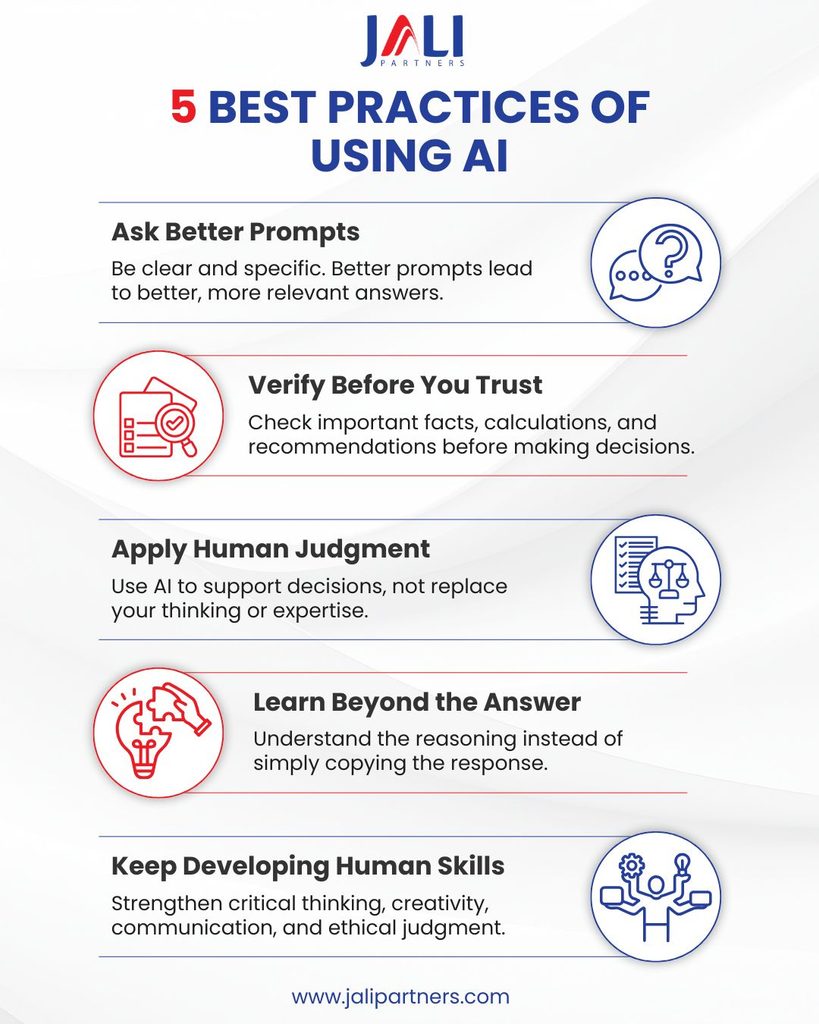
5 Best Practices of Using AI
The Competitive Advantage Isn’t AI, Its AI Literacy
Imagine two professionals with similar education and experience. Both have access to the same AI tools. One copies every answer without questioning it. The other uses AI to save time, verify ideas, explore alternatives, and improve decision-making while applying professional judgment. They have access to the same technology. Yet one consistently delivers greater value. The difference isn’t the AI. It’s how they use it. This is becoming true for organizations as well. As AI becomes widely available, competitive advantage will come less from having access to the latest tools and more from building a workforce that knows how to use them responsibly, critically, and effectively.
Don’t Outsource Your Thinking
Throughout history, new technologies have changed the way people work, but they have never eliminated the need for good judgment. Calculators didn’t replace mathematicians. Spreadsheets didn’t replace accountants. Search engines didn’t replace researchers. And AI won’t replace the need for professionals who can think critically, ask the right questions, and make sound decisions. Technology should expand our capabilities, not replace our responsibility to think.
Key Takeaways
Artificial intelligence is transforming the workplace, but the greatest risk is not AI itself. The real risk is becoming so dependent on technology that we stop questioning, verifying, and thinking critically. The professionals and organizations that will thrive are not those who rely on AI the most. They are those who know when to use it, when to question it, and when to rely on human judgment. Because AI can generate answers.
Only people can decide which answers deserve to be trusted.